Application Guide
How to Replace a Lead-Acid Battery with LiFePO4
A lead-acid replacement lithium battery is a LiFePO4 battery configured for equipment that previously used a lead-acid battery. The conversion can reduce weight and maintenance and improve usable energy, but it is not a label-to-label substitution: charger, load, size, terminals and operating conditions must be checked first.
Common Replacement Scenarios
Solar and lighting
Street lights, fishing-boat lighting, off-grid systems and small solar storage applications.
RV and marine
House batteries and auxiliary power for lights, electronics and onboard appliances.
Backup systems
UPS, communications, security equipment and emergency power where the load is confirmed.
Industrial equipment
Cleaning machines, instruments and other devices originally designed around lead-acid batteries.
What Changes When Lead-acid Is Replaced
| System item | Why it matters | What to confirm |
|---|---|---|
| Charger | Lead-acid and LiFePO4 charging profiles are different. | Charging voltage, current and whether the charger has unsuitable equalization or desulfation functions. |
| Load | The BMS must support continuous use and startup peaks. | Normal current, peak current, peak duration and equipment startup behavior. |
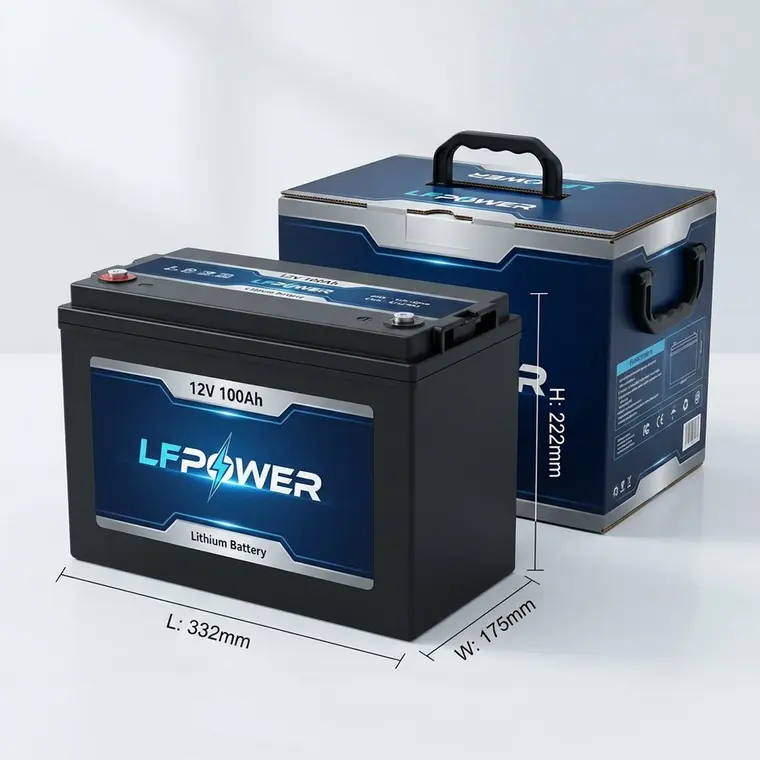
| Installation | A battery can have the right voltage but still not fit. | Length, width, height, terminal position, cable, connector and fixing method. |
| Temperature | Low-temperature charging needs specific protection or operating rules. | Minimum and maximum operating temperature and whether charging occurs below freezing. |
| State-of-charge display | Old lead-acid gauges may not read lithium batteries accurately. | Meter compatibility, communication or an alternative monitoring method. |
What Must Be Checked
- Nominal voltage and actual charging voltage of the existing equipment.
- Continuous discharge current and peak current during startup.
- Battery compartment size, terminal direction, cable connection, and fixing method.
- Operating temperature, especially low-temperature charging and discharge needs.
- Required labels, carton packing, safety documents, and shipping method.
Amp-hours alone are not a conversion rule. Two batteries marked 100Ah can perform very differently when the load, BMS current, charger and permitted depth of discharge are different.
LFPOWER Replacement Battery Support
LFPOWER supplies 12.8V batteries in multiple capacities and can discuss 24V or 48V pack directions for equipment manufacturers, distributors and brand customers. Depending on the project, buyers can confirm standard models, private labels, terminals, case requirements, packing and available documents before sample approval.
Send These Details for Model Matching
- A photo and label information of the old lead-acid battery.
- Equipment name, charger information, daily working time and load current.
- Battery-space dimensions, terminal direction, cable and connector photos.
- Required quantity, destination country, label and packing requirements.
- Any required MSDS, UN38.3, CE or other documents for the actual order.
Common Questions
Can I choose lithium only by the old lead-acid capacity?
No. Capacity is only one factor. Load current, charger, size, and usage pattern are also important.
Can LFPOWER customize the case and label?
For suitable order requirements, LFPOWER can discuss ODM case, label, terminal, packing, and configuration needs.
What information should I send for a replacement inquiry?
Send application, old battery model, voltage, capacity, size, load current, quantity, country, and document needs.
Check Whether Your Equipment Can Use LiFePO4
Send the old battery label, charger, equipment, current and installation-size information. LFPOWER will use the real application data to discuss a suitable replacement direction.
Send Replacement Requirements